
Revise and Conquer: KCSE Business Studies Revision
Revise and Conquer: KCSE Business Studies Revision equips learners with practical and analytical skills needed to understand the world of commerce, entrepreneurship, and financial management.
This comprehensive KCSE Business Studies revision guide by ReviseKenya.com is carefully structured to help students master Form 1–4 Business Studies concepts while applying real-world business logic and KCSE examination strategies.
Form 1 Topics: The Foundation of Business
Introduction to Business Studies & Environments
Explores the purpose of business, the economic environment, and how internal and external factors influence operations and decision-making.
Satisfaction of Human Wants
Covers human wants, scarcity, choice, and opportunity cost — the foundational principles that drive all economic activity and business decisions.
Production
Analyzes how goods and services are produced using the four factors of production — land, labour, capital, and entrepreneurship — and how efficiency impacts output.
Entrepreneurship
Highlights the qualities of an entrepreneur, methods for generating business ideas, and steps involved in creating and managing a new enterprise.
Office Functions
Covers the role and layout of an office, emphasizing record-keeping, communication, and administrative functions essential for smooth business operations.
Home Trade
Explains the chain of distribution, the role of wholesalers and retailers, and the importance of intermediaries in connecting producers and consumers.
Form 2 Topics: Business Organization and Operations
Forms of Business Units
Covers sole proprietorships, partnerships, cooperatives, companies, and public corporations, analyzing their ownership structures, advantages, and disadvantages.
Government and Business
Explores how the government regulates businesses, promotes fair competition, and supports entrepreneurs through policies, training, and infrastructure.
Transport & Communication
Discusses the modes of transport (road, air, water, rail) and types of communication, highlighting their significance in trade and service delivery.
Warehousing
Focuses on the types and functions of warehouses, storage management, and how warehousing supports efficient distribution of goods.
Product Promotion
Examines the marketing mix and strategies, including advertising, sales promotion, and public relations, that businesses use to promote their products and services.
Form 3 Topics: Market Forces and Business Growth
Demand and Supply
Covers the laws of demand and supply, determinants of market behavior, and how equilibrium price and quantity are established in the market.
Size of a Firm / Economies of Scale
Explores factors influencing business growth, including the benefits (economies) and challenges (diseconomies) of expanding operations.
Circular Flow of Income
Illustrates the interdependence between households and firms, explaining how money flows through production, income, and expenditure cycles in an economy.
Form 4 Topics: Advanced Business Decisions
Money and Banking
Explains the functions of money, the roles of commercial banks and central banks, and the importance of financial systems in supporting business activities.
Public Finance and Taxation
Covers sources of government revenue, types of taxes, and principles of equitable taxation. Discusses how taxation impacts both businesses and consumers.
International Trade
Examines trade between nations, the balance of payments, and the roles of regional trade blocs like EAC and COMESA in promoting growth.
Financial Statements
Teaches preparation and interpretation of income statements, balance sheets, and cash flow statements, essential for financial decision-making.
Business Growth Strategies
Analyzes methods of expansion such as mergers, takeovers, diversification, and franchising, including their benefits and risks.
Functional Management Decisions
Focuses on decisions in marketing, finance, operations, and human resource management, emphasizing the role of leadership and planning.
Key Skills to Practice for KCSE Business Studies
Application of Theory
Go beyond memorization — apply business concepts to real Kenyan business scenarios, case studies, and market problems.
Interpretation of Data
Develop the ability to analyze financial statements, demand/supply curves, and interpret economic data in graphs and tables.
Critical Evaluation
Practice evaluating business situations — compare ownership structures, discuss management decisions, and assess their implications.
Structured Essay Writing
Improve long-form writing with clear introductions, logical arguments, and concise conclusions, using correct business terminology.
Effective KCSE Revision Strategies
1. Master the KCSE Marking Scheme
Use ReviseKenya’s KCSE past papers and marking schemes to understand how marks are awarded for command words like explain, discuss, and evaluate.
2. Engage in Active Recall
Regularly test yourself with KCSE topical questions and interactive quizzes. Active recall strengthens retention and confidence.
3. Create Concept Maps
Draw visual mind maps connecting topics such as Entrepreneurship, Forms of Business Units, and Business Growth. This enhances integration and understanding.
4. Join a Study Community
Participate in ReviseKenya’s online study groups on WhatsApp or Telegram to discuss complex topics and share insights with peers.
5. Prioritize High-Weightage Topics
Focus more time on Financial Statements, Demand & Supply, and Business Management Decisions, which frequently carry high marks in KCSE exams.
By combining ReviseKenya’s structured resources with these strategic methods, students can revise efficiently, apply concepts effectively, and approach the KCSE examination with clarity and confidence.
Frequently Asked Questions (FAQs)
1. What is the best way to prepare for KCSE Business Studies?
Start by mastering the foundational Form 1 and 2 topics, then move to advanced business decision-making concepts. Use KCSE past papers and marking schemes to understand question formats.
2. How can I write better Business Studies essays in KCSE?
Use the PEE structure: Point, Evidence, Explanation. State your point clearly, support it with a real-world example, and explain how it answers the question.
3. Which Business Studies topics are tested most in KCSE?
Demand & Supply, Financial Statements, and Business Growth are highly recurring and carry significant marks. Focus your revision on these key areas.
4. Are case studies important for KCSE Business Studies?
Yes, case studies help apply theory to real-life situations, which examiners reward. Practice analyzing case-based questions for a practical understanding.
5. Where can I find KCSE Business Studies resources online?
Visit ReviseKenya.com for notes, schemes of work, topical questions, marking schemes, and KCSE past papers organized by topic and year.
Revise and Conquer KCSE Revision Series Subjects by ReviseKenya.com
- Revise & Conquer: KCSE Mathematics Revision
- Revise & Conquer: KCSE Biology Revision
- Revise & Conquer: KCSE Physics Revision
- Revise & Conquer: KCSE Chemistry Revision
- Revise & Conquer: KCSE English Revision
- Revise & Conquer: KCSE Kiswahili Revision
- Revise & Conquer: KCSE Geography Revision
- Revise & Conquer: KCSE CRE Revision
- Revise & Conquer: KCSE IRE Revision
- Revise & Conquer: KCSE Agriculture
- Revision Revise & Conquer: KCSE Business Studies
- Revision Revise & Conquer: KCSE Computer Studies
- Revision Revise & Conquer: KCSE Music Revision
- Revise & Conquer: KCSE Home Science Revision
- Revise & Conquer: KCSE French Revision
- Revise & Conquer: KCSE German Revision
ReviseKenya – Revise and Conquer KCSE Revision
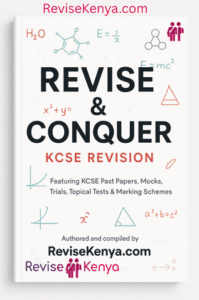
“Revise and Conquer – KCSE Revision” is a specific KCSE revision product by ReviseKenya.com that includes past papers, mock exams, and topical questions with detailed marking schemes.
Revise & Conquer: KCSE Business Studies Revision by ReviseKenya.com is more than just a subject guide; it’s a roadmap to mastering business thinking, applying knowledge effectively, and excelling in the KCSE exams.
Through structured revision, data interpretation, and essay writing practice, learners can develop critical reasoning and problem-solving skills that go beyond the exam room and into the real business world.