Revise and Conquer – KCSE Mathematics Revision
Mathematics remains one of the most crucial KCSE subjects, forming the backbone of problem-solving, logical thinking, and analytical reasoning across all fields of study. Revise & Conquer: KCSE Mathematics Revision equips learners with concise explanations, worked examples, and targeted practice questions to help them master both Paper 1 and Paper 2.
This KCSE Revision Series follows the Kenyan aligned KCSE syllabus, blending practical applications with theoretical understanding to help students confidently approach exams and real-world challenges alike.
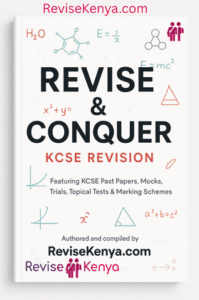
Revise and Conquer – KCSE Revision bring together KCSE Past Paper Questions, KCSE Mocks, KCSE Trials, KCSE Topical Test& KCSE Prediction Sets
Overview of KCSE Mathematics
KCSE Mathematics is divided into two papers:
Paper 1 (Core Mathematics): Focuses on arithmetic, algebra, geometry, and other foundational concepts.
Paper 2 (Applied Mathematics): Explores higher-order topics such as calculus, vectors, and probability.
Each topic is designed to test conceptual understanding, accuracy, and problem-solving efficiency. Below is a structured outline of the most frequently tested areas in KCSE Mathematics.
Key KCSE Mathematics Topics
1. Algebra
The foundation of all mathematical reasoning. Students learn to manipulate algebraic expressions, solve linear and quadratic equations, factorize polynomials, and analyze functions and inequalities. Mastery in algebra enhances logical reasoning and problem-solving speed.
2. Commercial Arithmetic
Applies mathematical reasoning to financial situations. Topics include profit and loss, simple and compound interest, discounts, commission, exchange rates, and percentages. This area directly connects mathematics to real-world commerce and everyday transactions.
3. Geometry
Covers the study of shapes, angles, and constructions. Learners explore properties of triangles, circles, and polygons, apply theorems, and use scale drawings and bearings to solve geometric problems.
4. Measurement
Focuses on computing length, area, surface area, and volume. Students also apply formulas relating density, mass, and volume in practical problems. These concepts are essential in physics, engineering, and design.
5. Trigonometry
Equips learners with tools to analyze relationships in right-angled and non-right-angled triangles. The syllabus includes trigonometric ratios, the sine and cosine rules, trigonometric equations, and graphs.
6. Coordinate Geometry
Involves representing and solving geometric problems on the coordinate plane. Learners study gradients, midpoints, distances, and equations of lines, forming the basis for analytic geometry.
7. Vectors
Introduces magnitude and direction. Students learn to represent vectors, calculate vector sums, prove collinearity, and solve problems involving translation and position.
8. Calculus
Focuses on differentiation and integration, their rules, and applications in finding gradients, rates of change, and areas under curves. Calculus forms the bridge between pure mathematics and applied sciences.
9. Statistics and Probability
Covers data collection, representation, and interpretation. Learners calculate mean, median, mode, variance, and standard deviation, and study probability to predict outcomes of random events.
10. Linear Programming
Introduces optimization techniques using inequalities and graphical representation. Learners formulate and solve real-life resource allocation problems.
11. Matrices
Focuses on matrix operations and their use in solving simultaneous equations and geometric transformations. This topic introduces students to abstract mathematical modeling.
12. Longitudes and Latitudes
Applies mathematical concepts to geography, enabling students to calculate positions, distances, and time differences on the Earth’s surface.
Why Study with Revise & Conquer: KCSE Mathematics Revision
Comprehensive Coverage: Every topic aligns with the KCSE syllabus.
Exam-Focused Approach: Emphasizes KCSE past papers, KCSE common question trends, and marking techniques.
Practical Examples: Real-life applications to enhance conceptual understanding.
Self-Paced Practice: Suitable for individual or group revision.
Model Answers: Clear solutions that follow KCSE marking guidelines.
Frequently Asked Questions (FAQs)
1. What is covered in KCSE Mathematics Paper 1 and Paper 2?
Paper 1 focuses on foundational mathematics: algebra, geometry, and commercial arithmetic while Paper 2 includes applied mathematics such as calculus, vectors, and probability.
2. How can I effectively revise for KCSE Mathematics?
Start with KCSE topic summaries, practice structured questions daily, and focus on problem areas. Use Revise & Conquer: KCSE Mathematics Revision to access KCSE topical exercises and model answers.
3. Which topics are most frequently tested in KCSE Mathematics?
Commonly examined topics include algebra, trigonometry, vectors, commercial arithmetic, geometry, calculus, and statistics.
4. How are marks distributed in KCSE Mathematics?
Each paper contributes 50% of the total marks. Both papers test accuracy, logical reasoning, and proper presentation of mathematical work.
5. What is the best way to handle word problems?
Translate the question into mathematical expressions step-by-step. Focus on identifying relationships between quantities before applying formulas.
6. Does Revise & Conquer include KCSE past papers and marking schemes?
Yes. It features KCSE past papers, KCSE mocks, KCSE topical tests, KCSE trials and marking schemes, helping students practice with real exam-style questions.
Explore More Subjects
Mathematics is not just about formulas, it’s about reasoning, creativity, and clarity of thought. With Revise & Conquer: KCSE Mathematics Revision, learners gain the skills, confidence, and strategy needed to excel in both Paper 1 and Paper 2.